
I found them mid-scroll on a Tuesday
It was the kind of lunch break that usually produces nothing except a vague awareness that I’ve been staring at my phone too long. Skincare ads, a recipe I’ll never make, someone’s vacation. And then this video appeared and I put my fork down.
Women at a national competition, performing haka. I’d never seen it before, never heard of it. I started crying almost immediately — the embarrassing kind, the kind you can’t really explain to yourself. Something about watching them felt like being reminded of something I’d forgotten, except I couldn’t tell you what.
I kept thinking about it for days after. So I started reading.
What I got wrong before I got it right
My first instinct, I’ll admit, was the obvious Western one: isn’t haka a rugby thing? A men’s thing?
It’s not, and the history is more interesting than the stereotype. Haka is an ancient Māori practice — part ceremony, part storytelling, part spiritual technology — and women have always been part of it. The colonial period buried that, as colonial periods tend to do, but the tradition never actually disappeared. According to Māori oral history, the very first kapa haka group was assembled by women, atua wāhine, female deities gathered by Tinirau. Women have always led the karanga, the ceremonial call of welcome. At Te Matatini, the national kapa haka competition, the manukura wahine — the female leader — is a distinct, celebrated role.
What we’ve mostly seen in the West is the sanitized export version: rugby warm-ups, tourist performances. Real haka, full haka, is something else. The facial expressions aren’t for intimidation. The stomps and chants are about channeling something bigger than yourself, about making your ancestors present in the room.
The thing that made me cry
I think what hit me was the permission in it. These women were not performing for anyone’s comfort. They were not adjusting their volume or softening their faces or making themselves easier to look at. Their feet were planted. Their eyes didn’t move. Their voices carried.
Most of us spend an enormous amount of energy managing how we come across — being confident but not arrogant, assertive but not aggressive, taking up space but apologizing for it slightly. It’s so constant and so normalized that we don’t even notice we’re doing it until we see someone who isn’t.
That’s what stopped me. Not the tradition itself, at first, but the refusal to modulate.
The women doing it right now
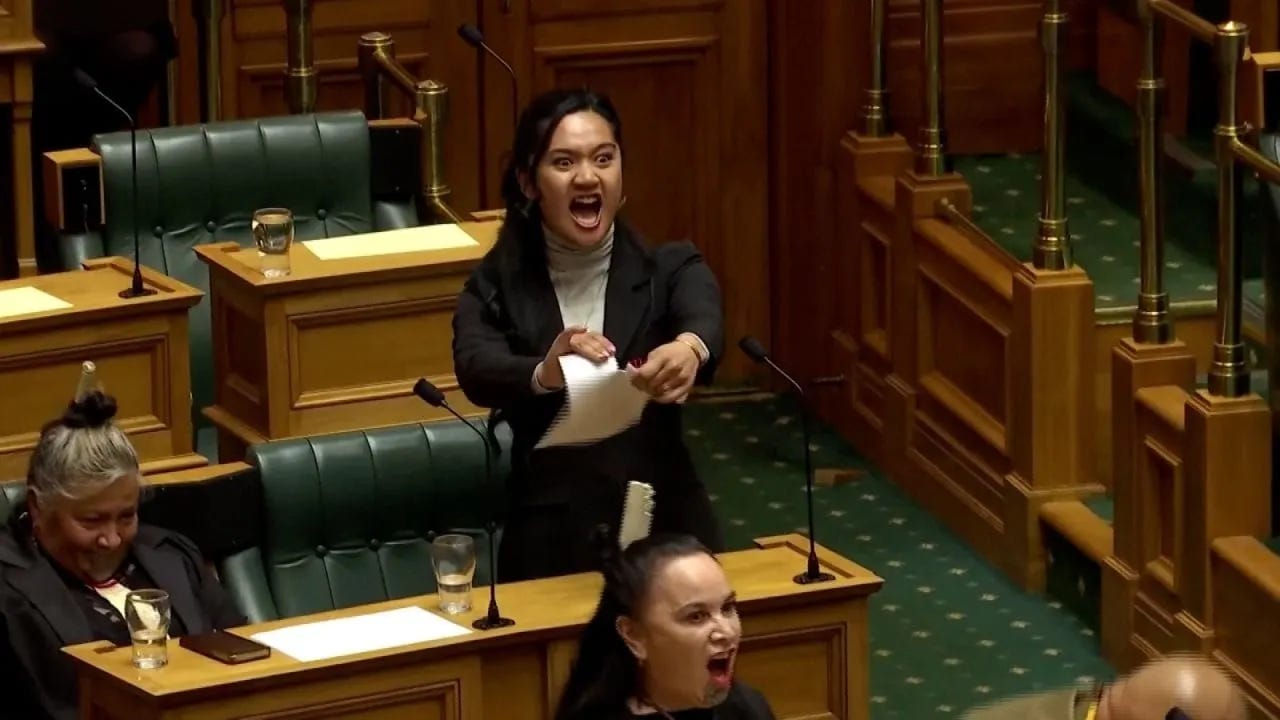
In November 2024, Hana-Rāwhiti Maipi-Clarke, 21 years old, the youngest MP in New Zealand’s history — stood up in parliament, tore up the Treaty Principles Bill, and broke into haka. She was suspended for seven days. TIME named her one of the most influential people of the year.
Portia Woodman-Wickliffe has led the Black Ferns, New Zealand’s women’s rugby team, in haka at the Rugby World Cup. Not as pageantry. As a declaration.
Dame Hinewehi Mohi has spent decades as a cultural ambassador for kapa haka, arguing that it’s it’s medicine, identity, and resistance in the same gesture.
None of them asked for the floor before they took it.
What I’m still thinking about
I’m not saying we should all learn haka. That’s not the point and it’s not mine to say. But I keep coming back to the image of those women at the competition, and the question it planted: what would it feel like to stop performing weakness? Not to perform strength either — but to just be in your body, taking up space, not managing the temperature of the room for everyone else’s sake?
The warrior, as the tradition suggests, isn’t something you construct. She’s already there. We’ve just spent a lot of years learning to keep her quiet.