
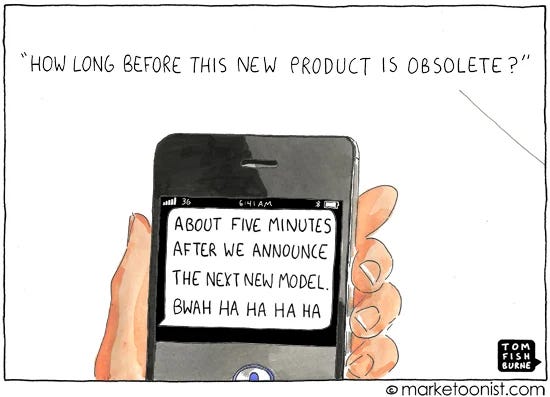
Amazon is about to cut off Kindle Store access for every e-reader released before 2013. Two million devices, still working perfectly, will simply lose the ability to download new books. Not because they’re broken or have stopped doing what they were built to do but because someone at a company decided their time was up.
These Kindles hold a charge. They display text beautifully. They’ve sat on nightstands and been tucked into carry-on bags and cracked open on Sunday mornings for over a decade. And now they’re being quietly phased out.
When I came across this story, I wasn’t thinking about storage capacity or software updates. I was thinking about women. Women I’ve sat across from in meetings. Women who’ve sent me messages at 11pm wondering what they did wrong. Women who are extraordinarily good at their jobs and somehow still find themselves having to prove it, over and over again, in ways their male colleagues simply never do.
Because what Amazon is doing to these Kindles is something women in the workforce have been living through for a long time.
You’re still sharp and capable. You’ve spent years, maybe decades, building expertise that genuinely cannot be replicated by someone who graduated three years ago and learned everything from a YouTube tutorial. But at some point, without any real conversation or honest feedback, someone decided you were past your prime. And from that moment on, everything gets a little harder to access. The interesting projects and strategic meetings. The opportunities that seem to materialize easily for people who are younger, cheaper, and far less experienced than you.
The research on this is hard to sit with. Women start facing age discrimination in hiring in their 40s. Men typically don’t encounter the same thing until their 50s. So women are essentially navigating a system that considers them “old” a full decade earlier, while simultaneously being told they’re imagining things or being too sensitive about it.
And on top of that, the rules are completely contradictory. You’re supposed to stay current without looking like you’re trying too hard. You’re supposed to have deep experience without coming across as inflexible. You’re supposed to be confident and direct but not so much that people find you difficult. There is no version of yourself that clears all those bars at once, because they weren’t designed to be cleared. They were designed to give someone a reason to pass you over no matter what you do.
The Kindle thing hit me so hard precisely because of how perfectly it maps onto this. Those devices aren’t obsolete in any meaningful sense. They work. They do exactly what a reading device is supposed to do. But they’ve been cut off from the ecosystem that gives them their purpose, and that cutoff has nothing to do with their actual capabilities. It’s just a business decision someone made, dressed up as inevitability.
That’s what happens to experienced women in so many organizations. The capability is still there, completely intact. What disappears is the access. You stop getting pulled into the room where decisions get made. You stop being considered for the stretch assignment. You stop being invested in. And eventually, the message becomes clear even if nobody ever says it out loud.
Companies do this and then act surprised when institutional knowledge walks out the door. They spend months trying to figure out why things aren’t running as smoothly as they used to, why the new hires keep making the same avoidable mistakes, why clients are less satisfied. The answer left in a cardboard box six months ago.

What I keep coming back to is that obsolescence is never really inevitable. Someone decides what counts as outdated. Someone decides whose experience is an asset and whose is a liability. And those decisions are almost never purely about performance or value. They’re about bias, about cost-cutting, about a cultural preference for the new and shiny that has very little basis in actual results.
So if you’re in this, here’s what I think actually helps.
Stop internalizing someone else’s expiration date. The timeline that’s been quietly assigned to you is not a fact about your worth. It’s a reflection of someone else’s limitations, and you are allowed to reject it completely.
Keep a running record of what you contribute. I don’t mean this as a defensive move, though it can serve that purpose. I mean it because bias has a way of making real things feel invisible, and having something concrete to point to matters, both for how others see you and for how you see yourself.
Make a genuine effort to connect with people at different stages of their careers, not strategically, but because those relationships are actually interesting and valuable. The narrative that experienced workers can’t relate to younger colleagues is lazy and wrong, but it persists because people let it. You can be the person who makes it obviously, visibly untrue.
And if the organization you’re in genuinely doesn’t see what you bring, that is information worth taking seriously. Some Kindle owners are switching to other platforms because the company that made it made them. The same logic applies here. There are places that actually understand what experience is worth.
Your experience is not baggage nor a red flag. It is, genuinely, one of the most valuable things you have. And unlike a piece of hardware waiting on a server update that will never come, you get to decide what happens next.